Climate Change
Climate change is already a reality, with noticeable effects across the planet. Extreme events such as floods, prolonged droughts, and heatwaves have intensified, causing direct impacts on society, the economy, and business operations. The electricity sector, which is highly dependent on natural resources, is particularly vulnerable to these climate events, as evidenced by the floods that hit Rio Grande do Sul in 2024.
In 2015, during COP21, the Paris Agreement was established with the goal of keeping the increase in global average temperature well below 2°C, while pursuing additional efforts to limit it to 1.5°C above pre-industrial levels. In 2024, during COP29, Brazil announced its new Nationally Determined Contribution (iNDC), committing to reduce emissions by 59% to 67% by 2035 compared to 2005 levels.
CPFL Energia, in turn, has also set ambitious targets: to reduce absolute emissions by 56% by 2030, based on the 2021 inventory, and to achieve carbon neutrality starting in 2025 through mitigation actions and voluntary offsets. This commitment is part of the company’s 2030 ESG Plan, which now also includes a new commitment focused on climate resilience, in response to the growing risks associated with extreme events.
While we face operational risks — such as the impact of drought on hydroelectric generation and infrastructure damage from intense rainfall — the climate scenario also presents opportunities for innovation and value creation. These include: expansion of renewable energy generation, advancement of electric mobility solutions, carbon credit and I-REC trading, development of energy efficiency solutions, among others.
These actions strengthen CPFL's position as an active agent in the transition to a low-carbon economy, focusing on sustainability, innovation, and resilience.
Our journey in combating Climate Change
In 2021, we launched the first version of the document "Our Journey in the Face of Climate Change", aiming to provide greater transparency about the evolution of our climate management model and the mitigation and adaptation practices adopted by the company in the transition to a low-carbon economy. Since then, the content has been updated annually.
The most recent version, published in 2025, reflects the progress driven by the 2030 ESG Plan, details the physical and transition risks associated with climate change that affect our business, presents targets and metrics for monitoring greenhouse gas (GHG) emissions, and highlights the main ongoing decarbonization initiatives. It also outlines how CPFL engages its value chain, including suppliers and partners, in addressing the climate crisis and building low-carbon solutions for clients and communities.
Four Fronts of Action
To face climate change, we assess and implement different actions to adapt our businesses and mitigate impacts related to our activities, especially the emission of greenhouse gases. Our initiatives are centered on four fronts of action, broken down into actions and guidelines for project execution.
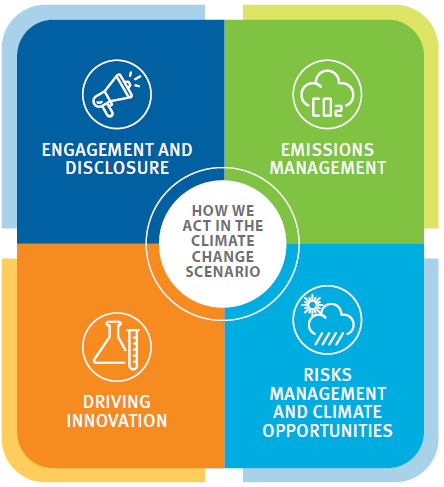
Greenhouse Gases (GHG) emissions Management
CPFL Energia annually inventories its greenhouse gas (GHG) emissions, systematically monitoring the volume of emissions resulting from its activities. The inventory is prepared in accordance with the guidelines of the Brazilian GHG Protocol Program, based on internationally recognized methodologies, and is verified by an independent third party accredited by Inmetro, ensuring its robustness and credibility. The data is public and recorded in the Public Emissions Registry, earning the Gold Seal since 2011.
The inventory includes Scopes 1, 2, and 3, broken down by business units (generation, transmission, distribution, and solutions), and considers intensity indicators, such as emissions per energy generated, distributed, and net operating revenue.
For more quantitative information about our inventory, please refer to our main reports: Public Emissions Registry, Annual Report, and Our Journey in the Face of Climate Change.
Management of climate risks and opportunities
In order to manage climate risks and opportunities, we have developed a Map that consolidates the main impacts that we are susceptible, such as changes in physical climate parameters and changes in regulations, in addition to the main opportunities for the development of new products and services. We report this map, as well as other actions, in the CDP. Based on data reported through CDP's 2024 Climate Change questionnaire, CPFL Energia received an 'A-' grade.
Innovation
Innovation is a strategic lever for the growth of our business and the diversification of CPFL Energia’s portfolio. We operate through structured fronts, such as the Research and Development (R&D) program regulated by ANEEL, and initiatives integrated into the 2030 ESG Plan, focusing on sustainability, digitalization, and energy transition. We also lead projects focused on climate change mitigation and adaptation, especially in the context of renewable generation and energy distribution. These projects contribute directly to our emissions reduction and climate resilience commitments outlined in our 2030 ESG Plan.
Solutions for the energy transition
As part of our commitment to the sustainable development agenda, we offer solutions that support our clients in transitioning to less carbon-intensive production models. We invest, for instance, in projects that generate carbon credits to offset greenhouse gas (GHG) emissions.
Currently, our portfolio includes 11 projects, registered in both the regulated market (CDM) and the voluntary market (VCS). Another product we offer, through CPFL Soluções, is Renewable Energy Certificates (I-RECs), which guarantee that free market clients are purchasing energy from renewable sources. We currently have 44 projects registered for I-REC trading.
CPFL Soluções
Engagement and promotion
We participate in various national and international initiatives related to climate change, aiming to promote best practices in management, transparency, and decarbonization. These commitments reinforce our alignment with the climate agenda and are directly connected to our 2030 ESG Plan.
In 2018, we became signatories of the Task Force on Climate-related Financial Disclosures (TCFD). This initiative guides organizations in assessing and reporting the physical and transition risks of climate change that may impact their businesses, promoting greater transparency and better-quality information for financiers, insurers, investors, and other stakeholders.
In addition to TCFD, we are involved in other relevant initiatives, such as:
- CDP (Carbon Disclosure Project), where we report our climate actions annually;
- UN Global Compact, highlighting our participation in the Business Ambition for 1.5°C/Net Zero movement;
- Brazil Network of the Global Compact, which promotes decarbonization among Brazilian companies.
These initiatives contribute to strengthening climate governance, integrating environmental risks into corporate strategy, and achieving the carbon neutrality targets committed to by CPFL.